


Prima Facie: Criminal and Civil Court cases are all Commercial in nature

Correct. This is true. Eye will show you how eye came to this conclusion.
Download this (portable document file) .pdf, as it will be a key reference in this article.

Disclaimer Clause: The contract that was brought into court by the juridical person known as The State, or State of Florida through its contracted agent, the City of Tallahassee Police Department.
This information is public, therefore, it is not confidential information, however it is being provided with good faith (bona fide), under equity, to you as a beneficiary in trust, and it is expected that you reciprocate that by not utilizing any of the information provided to you, in bad faith (mal fide), to provide the truth over matters that affect any one of the people that have business matters with entities such as "The State", or "State of ... ". This is to maintain a realistic, and relatable situation that anyone in this realm, could find themselves in.
Here is the public record .pdf:

Let us look at page 1.
This page provides us quite a few clues to this. "In addition, the constitution provides that funding for the state courts system shall be provided from state revenues appropriated by general law, while funding for clerks’ court-related functions must be provided by adequate and appropriate filing fees, service charges, and court costs assessed to parties accessing the courts.1
The superscript references this information : "1. The Legislature established the State Courts Revenue Trust Fund and the Clerks of the Court Trust Fund to create a dedicated state revenue stream for court-related activities. In practice, both the clerks and the courts are funded with revenues assessed by the courts and collected by the clerks; courts also receive General Revenue appropriations."
Notice Florida Statute here 736.0101 Short title.—This chapter may be cited as the “Florida Trust Code” and for purposes of this chapter is referred to as the “code.”
History.—s. 1, ch. 2006-217.
...leading to...
Notice 736.0106 Common law of trusts; principles of equity.—The common law of trusts and principles of equity supplement this code, except to the extent modified by this code or another law of this state.
History.—s. 1, ch. 2006-217.
...leading to...
Notice 2.01 Common law and certain statutes declared in force.—The common and statute laws of England which are of a general and not a local nature, with the exception hereinafter mentioned, down to the 4th day of July, 1776, are declared to be of force in this state; provided, the said statutes and common law be not inconsistent with the Constitution and laws of the United States and the acts of the Legislature of this state.
History.—s. 1, Nov. 6, 1829; RS 59; GS 59; RGS 71; CGL 87.
..leading to...
Notice 29.22 State Courts Revenue Trust Fund.—The State Courts Revenue Trust Fund is created within the state courts system. Moneys credited to the trust fund shall be used for the purpose of funding the activities of the state courts system.
History.—s. 1, ch. 2009-7; s. 2, ch. 2011-19.
Before we continue, it is important to know that we are operating within Trust. This is why the Substantive Law, coded in Florida's statutes concerning trusts was referenced first. Trust is the realm where it is the currency, and is the way of life. Now that we have established that the feminine artificial person known as State of Florida (recognized as a "she") recognizes trust, onto the next point.
Common Law is recognizable within her statutory jurisdiction, as well as within her invisible borders. It is within the code, it clearly states that both equity and the common law of trusts are recognized. This is followed up by the next statute thus reaffirming the recognition and applicability of common law and equity within her borders and under her statutory jurisdiction.
Finally, we see that the statute states that the State courts have a trust fund that is used as a form of revenue to fund "the activities of the state courts system."
3 forms of recognition.
Moving onto page 2 of article 19-14
"The financial obligations assessed against participants in the court system fall generally into three categories: fees, fines, and restitution. Fees (also known as costs) are amounts authorized by statute that represent what a user of the court system is expected to pay. All court users are assessed fees. For example, someone filing a lawsuit in a civil case has to pay a filing fee. In criminal cases, fees assessed against defendants include the state’s cost to prosecute the case. Fines are imposed by the court as part of the judgment and are used to punish offenders.3 Fine amounts are correlated with the seriousness of the offense. Finally, restitution is intended to make the victim whole.
The fines and fees assessed in criminal cases are described in statute...
Fees are also detailed in statute. Some fees are assessed in every criminal case. For example, s. 938.05 (1)(a), Florida Statutes, requires any person pleading guilty to or found guilty of any felony or misdemeanor to pay a cost of $225 for a felony or $60 for a misdemeanor.."
It goes on to state in the superscript, " 3 Fines are assessed in misdemeanor and felony criminal cases, criminal and non-criminal traffic cases, and non-criminal ordinance violation cases.
Let us now look at page 3.

* ACTIVELY IN PLAY FOR EACH UTC. *
This is a fee distribution schedule to which accounts the funding is going. The paper trail.
Key things to notice are:
Local Law enforcement have a financial interest first.
Process: Each Uniform Traffic Citation (U.T.C.) is generated, is attached to the Name that is attached to the Official State Identification, or federally recognized Passport (card or booklet). This same name is also attached to the Certificate of Live Birth (Land Title), and the Social Security Account number, as an employee. These 3 instruments are used to triangulate the proper account and person that will be held responsible for the effect of the ticket.
Each U.T.C. has a total financial amount that must be paid, even if you are not summoned to court in the ticket. That total amount is the same as the amount viewed on the Court Docket. View the following real example:

Onto page 4 of the 19-14 OPPAGA article:

*They want their money, even if it means more court. Where is the forgiveness by The State?
*Red Star Note: Here is how it is done, well.
Next, page 5:

Next, page 6:

Note the Source is the Court Operations Corporation.
Next, page 7:

Next, page 9:

Next, page 10:

Next page, 11:

Next, page 12:
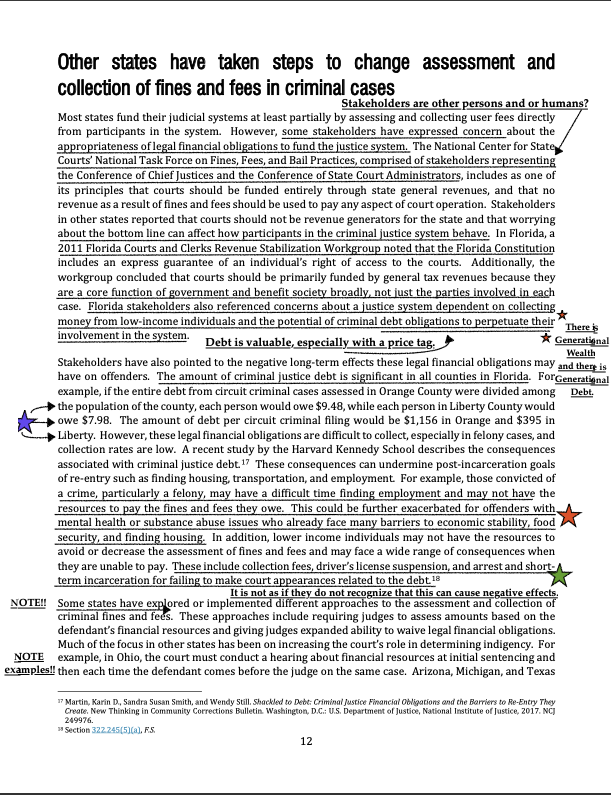
Final page, 13:

THIS ARTICLE 19-14 OF THE FLORIDA OPPAGA REPORT PROVIDES PRIMA FACIE EVIDENCE THAT ALL CRIMES ARE COMMERCIAL / CIVIL IN NATURE.
Even if you are in a separate state, there is a department of Motor Vehicles, and they have a police force that regulates and enforce codes and policies. These very codes and policies can be and have been shown to violate the inherit inalienable rights that The People have.
An Artificial Person has created another artificial entity to maintain, and continue generating revenue for its own purposes under trust law.
Civil / Criminal charges, and causes, are evidence of financial statements attached to the taxing system. It would be wise if you make sure to process these contracts and financial statements appropriately.
***END OF ARTICLE***


Comments